You didn't. Around sixteen weeks, a baby's brain quietly rebuilds the way it sleeps — and almost no one warns you it's coming. I'm a NICU nurse and a mother of three, and I missed it too. This is the reset I wrote on my own bedroom floor at 3 a.m.
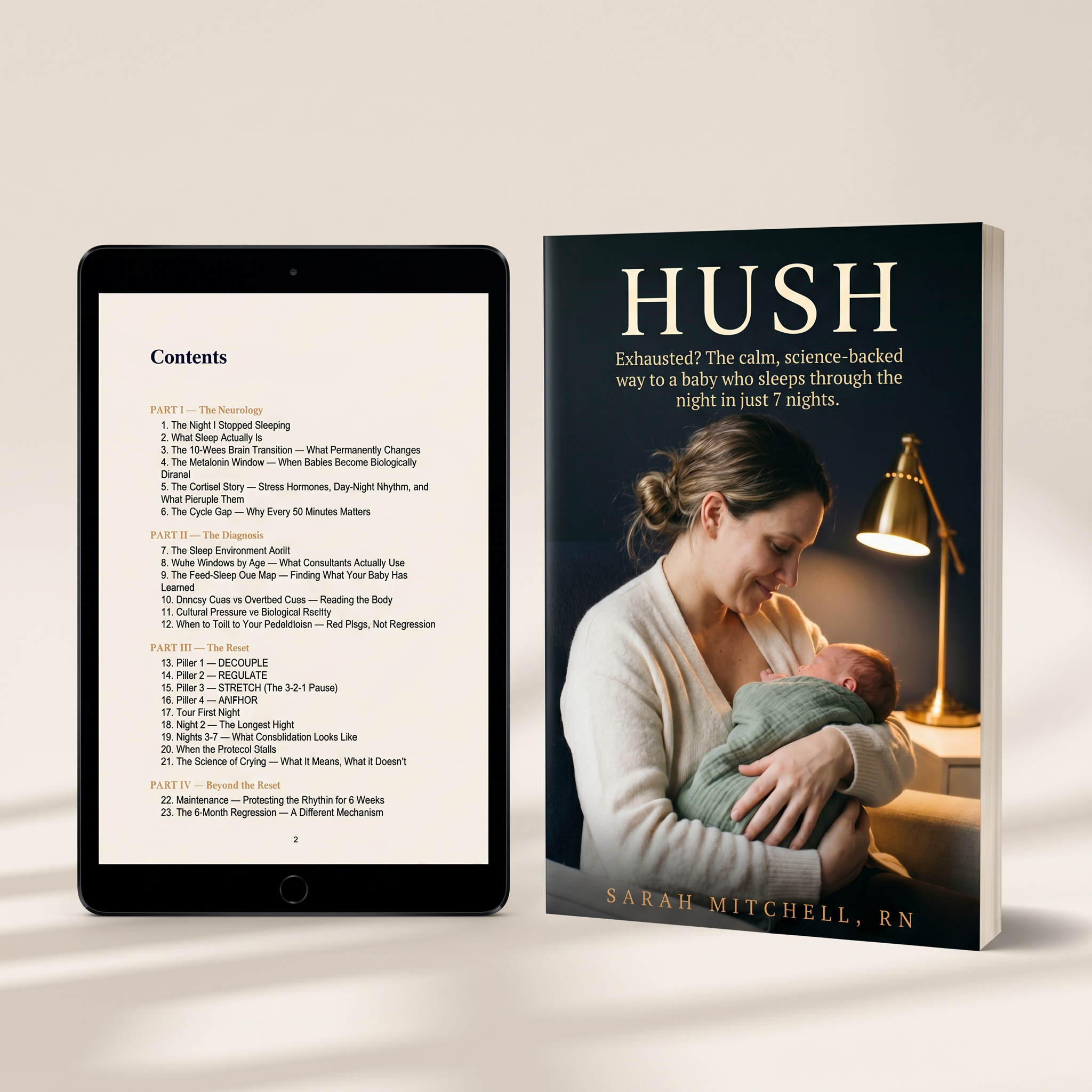
Get The Hush Method — $19 Instant download (PDF + ePub) — read it on any phone, tablet, Kindle, or e-reader, before the next feed.
You already know the time, don't you. You've checked it four times this hour — the way you check a clock when you're trying to negotiate with it.
If he goes down by 2:30, I get three hours. If he goes down by 3:00, the day just starts at 5:30 anyway.
You've heard all of it. The pediatrician who shrugs and says "it's a phase." The mother-in-law who says "all babies do this." The mom groups at 3 a.m. whispering "hang in there, it ends."
So you wait. Six weeks, maybe eight. You nurse through it. You try a schedule for three nights, a different one for three more, drowsy-but-awake for three more — and you abandon each one, because you're too exhausted to run an experiment that takes longer than seventy-two hours.
And some night, around week five of it, you find yourself crying in the shower so no one can hear you. Standing in the hallway at 4 a.m., watching someone who isn't on duty sleep with their mouth slightly open, feeling something that frightens you a little.
I need you to hear this, because no one said it to me: that feeling does not mean what you're afraid it means. It means you're a mammal who hasn't slept. That's all it means.
Here is the part that changed everything for me, sitting on my bedroom floor with thirty-one tabs open and the word ARCHITECTURE written across a page and underlined twice:
It wasn't that he stopped sleeping. It was that his brain grew up overnight.
The "4-month regression" isn't a regression at all. It isn't behavior. It isn't a habit you accidentally created by rocking him last Tuesday.
Around sixteen weeks, the newborn sleep your baby was running on — long, soft, forgiving — permanently restructures into the adult pattern. They begin cycling through lighter and deeper sleep roughly every fifty minutes, and at the end of every cycle they surface to the very edge of waking. You and I do this too. We just roll over and never remember it.
Your baby hasn't learned that part yet. So at every surface, they call for you. Not because they're hungry. Not because they're broken. Because for sixteen weeks, that exact moment has meant being fed or rocked — and their brain is simply asking for the thing it has always been given.
You feed them. They go down. Fifty minutes later, the cycle repeats. And again. And again.
That's not a regression. It's a loop. And the longer it runs, the harder it gets to break — which is exactly why some babies are still waking every ninety minutes at eight months, at eleven months, at a year.
The Hush Method is how you break the loop in seven nights — without cry-it-out, without abandoning anything, whether you crib-sleep or co-sleep.

For twelve years I worked the neonatal intensive care unit at one of the largest children's hospitals in the country. I've cared for babies who weighed less than a pound of butter. I thought I understood infant sleep.
Then my second son hit sixteen weeks, and I didn't sleep more than ninety minutes at a stretch for six weeks. Everything I'd learned in nursing school failed. Every app failed. The pediatrician shrugged.
So one night, instead of crying, I opened my laptop and started reading the actual research — the papers underneath the blog posts. I found the pattern. I built the protocol on my bedroom floor.
When my third son turned sixteen weeks, I ran it. By the end of that first week, we had our first long stretch in months — and the nights kept getting longer from there. I wrote this book so you don't have to find it the hard way, at 3 a.m., the way I did.
Not a schedule to obey. A sequence to follow — gently, in your own home, starting tonight.

Loosen the feed-and-rock-to-sleep reflex that's training your baby to need you at every cycle — without taking the comfort away.
The light and timing cues that settle a baby's brand-new internal clock — the ones most of us miss by an hour.
The single hardest few minutes of the week — and it is not cry-it-out. Hand on the chest. You stay. You're never out of the room.
Why the daytime quietly decides the nighttime — and the handful of nap rules that lock the whole reset in place.
You can read the whole thing in one sitting. You can start applying it tonight.
It broke me. So there's a page written for exactly that moment — the 3 a.m., one-handed, "I don't think I can do this" moment. It's the page most parents end up reading to themselves like a lifeline. You'll know it when you get there.
No — and this is the most important promise on this page. Cry-it-out methods leave a baby to cry alone. The Hush Method explicitly does not. You stay near. You re-enter with a hand on the chest. You soothe. What you remove is not your presence — it's the automatic reflex that's teaching your baby to need a feed or a rock every fifty minutes.
Every baby has a different personality — yes. But every sixteen-week-old human brain moves through the same transition. The biology underneath is universal. What changes per baby is how fast the reset takes — not the direction.
Most likely you tried a behavior program on a biology problem. The big-name programs are schedules — they assume your baby just needs more structure. The Hush Method assumes your baby's brain just rebuilt itself and needs you to update what you're doing accordingly. It's a different category.
You're in the room or just outside it, the whole time. You respond. You stay attached. The reset is built around connection, not the withdrawal of it.
Read it. Run the reset. If you don't see things moving in the right direction, email me within 30 days and I'll refund every dollar — and you keep the book. I built this for the version of me who was crying on the bathroom floor. If it doesn't help you, you owe me nothing.
The book lands in your inbox the moment you check out. You could be reading it during the next feed — and for the first time in weeks, every 2 a.m. wake will mean something different.
Turn the page when you're ready. I'll be right here.
— Sarah
The complete book in PDF and ePub — read it on your phone, tablet, Kindle, or any e-reader (or print it). It arrives by email the moment you check out — usually within a minute.
Yes — the method still applies up to around six months. It can simply take a little longer, because the loop has been running longer.
No. The method is feed-method neutral, and the book explains exactly how to apply the first pillar while keeping the breastfeeding relationship fully intact.
Yes. The hardest moments — including the Night-2 page — are written with the solo parent in mind. Many of the parents this was written for are doing it on their own.
Please talk to your pediatrician first. This book is an educational guide for healthy babies in the typical sixteen-week window — it isn't medical treatment and isn't a substitute for your pediatrician's advice.
Correct. You stay with your baby, you respond, and you re-enter with a hand on the chest. It's a different approach entirely from leaving a baby to cry alone.